Current range selection is one of the key decisions that determines how much information you really extract from a potentiostat experiment. It governs both the maximum measurable current and the smallest current change you can reliably detect.
Why current ranges matter
When you select a current range, you are fixing the trade‑off between headroom and sensitivity. A higher range allows you to measure larger currents but increases the size of each digital current “step”, so small features can be hidden in the noise. A lower range improves resolution and signal‑to‑noise ratio, but the signal will clip or saturate if the current exceeds the range limit.
This directly affects peak shapes in voltammetry, the quality of impedance spectra, and the precision of kinetic or diffusion parameters that you extract from your data, especially in low‑current processes such as corrosion, coatings or microelectrodes. For demanding quantitative work, choosing the correct range is as important as choosing the correct technique.
Manual vs automatic current ranging
Most modern potentiostats offer a combination of manual and automatic current ranging. With a fixed range, you know exactly which sensitivity you are using, and you avoid any risk of artefacts from on‑the‑fly range changes during fast or low‑noise measurements. This is typically preferred when the expected current is known and you need maximum reproducibility.
Automatic current ranging is especially valuable in exploratory experiments or whenever the current can span several orders of magnitude within a single method. The instrument monitors the signal and switches ranges up or down to keep the measured current within an optimal window. Well‑implemented automatic ranging makes methods simpler to program and more robust for non‑expert users, while still giving access to the full dynamic range of the hardware.
Current range management in IviumSoft
Ivium potentiostats controlled by IviumSoft place a strong emphasis on flexible, fine‑grained current range control. Users can typically access a wide span of current ranges, from ultra‑low values suitable for pA–nA signals up to A‑level currents when using power boosters, with enough intermediate steps to optimize sensitivity at each decade.
IviumSoft lets you:
Choose fixed current ranges when you need strict control over sensitivity and reproducibility.
Use automatic current range selection across all available ranges when you expect large current variations or when you are still characterizing a new system.
Combine both approaches in a single method, for example using automatic ranges in screening steps and fixed ranges in the final, quantitative measurements.
For users working in corrosion, coatings, batteries, hydrogen or heritage applications, this flexibility means you can use the same software and hardware platform across very different current levels without compromising data quality.
How the number of current ranges impacts measurement quality
The number of available current ranges, and how they are spaced, has a direct influence on what you can see in real experiments. If an instrument only offers a few, widely spaced ranges, you are often forced to choose between having enough headroom to avoid overload and having enough sensitivity for small signals. In such cases, low‑level currents may sit near the bottom of a high range, where the effective resolution is poor.
By contrast, systems with a denser set of ranges, including ultra‑low current options, allow you to “zoom in” on very small signals while still keeping the option to work at much higher current levels on the same instrument. This is particularly important in techniques where both capacitive and faradaic currents can span several orders of magnitude across the same potential window.
Comparing IVIUM with others
Below is an illustrative comparison of typical current‑range coverage in IVIUM instruments versus selected models from other manufacturers. Values are indicative and meant to show span and granularity rather than exact limits.
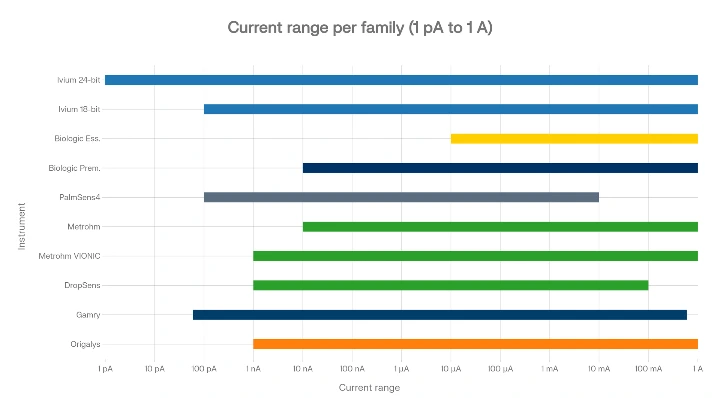
IVIUM’s 24‑bit potentiostats (CompactStat2 and IviumStat2) stand out because they cover the full current window from true pA up to ampere‑level currents in a single ecosystem, while still offering fine granularity in the low‑current ranges that really matter.
Compared with many competitors, which only cover parts of this window or offer fewer current ranges, IVIUM delivers both wider span and denser range distribution in one platform. This means that laboratories sometimes end up acquiring supposedly ‘premium’ or ‘pure’ instruments that, when you look closely at the current‑range specifications, are not actually as premium as they appear on paper, whereas IVIUM combines high‑end performance with a more versatile and future‑proof solution, simplifying method transfer between applications and reducing the need for multiple specialized potentiostats.